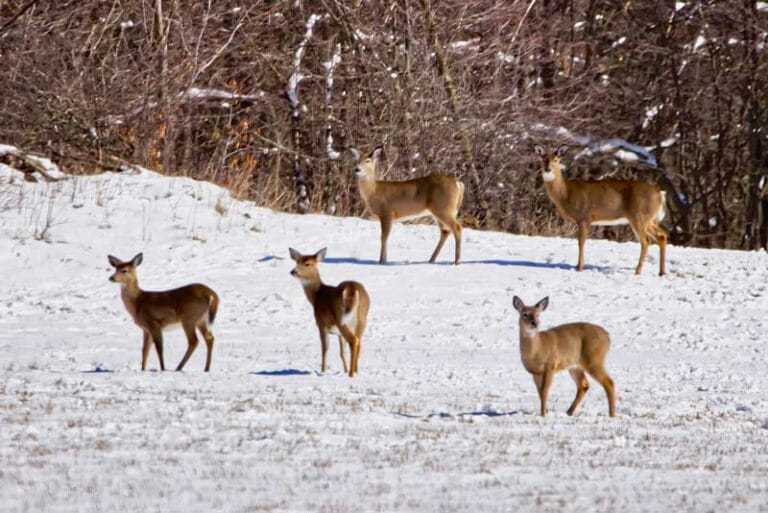
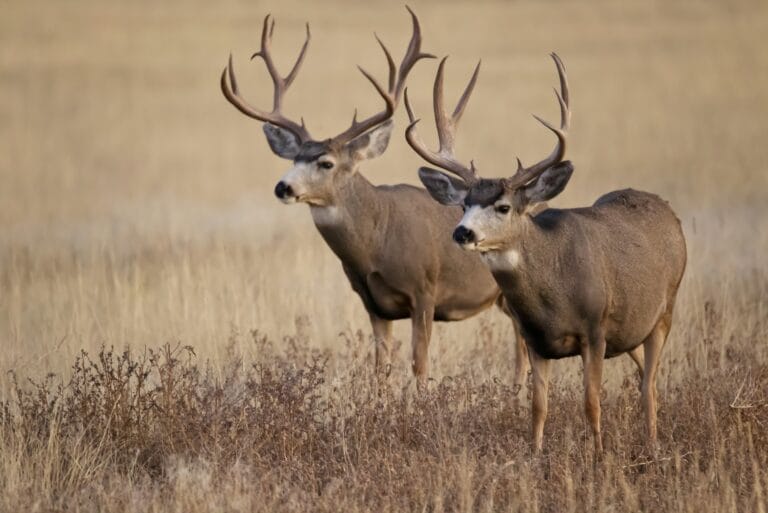
Chronic wasting disease (CWD) remains one of the most significant wildlife health threats facing North America’s cervid populations, including deer, elk, and moose. The disease also has serious implications for Indigenous communities, hunters, and the broader public who rely on wildlife for food security, cultural practices, recreation, and local economies. Ongoing monitoring is essential, as early detection provides the best opportunity to limit the spread of the disease and protect healthy cervid populations. Data collected through surveillance programs helps scientists and wildlife managers understand where CWD is emerging, how it is moving across the landscape, and which management actions are most effective, enabling adaptive management and timely, science-based decision-making.
Response in British Columbia
Chronic wasting disease (CWD) was first detected in British Columbia in January 2024 in white-tailed deer and mule deer in the Kootenay region. During the 2025–26 surveillance season, three additional cases were identified through hunter-submitted samples from male white-tailed deer. To date, nine cases of CWD have been confirmed in the province, all originating from the established CWD management zone in the Kootenay region. The measures implemented as part of B.C.’s response have been informed by expert recommendations, proven management approaches used in other jurisdictions, and input from partners. The province’s ongoing efforts remain focused on surveillance and risk mitigation to reduce transmission, while preventing spread into new areas and limiting the impacts of CWD as much as possible.
As part of mitigation efforts, a general open season deer hunt was implemented in a specific area surrounding Cranbrook from Jan. 5-31, 2026, to bolster sampling efforts and reduce the risk of CWD spreading to surrounding deer and elk populations. The Cranbrook area hunt targets deer populations near Cranbrook, where a cluster of CWD cases has been identified. The objectives of the hunt are to remove infected animals from the landscape, reduce the density of deer in the immediate and surrounding area of Cranbrook and reduce the outward movement of deer from within the hunt boundaries.
Cranbrook Hunt Results
- 228 deer were harvested during the 2026 Cranbrook area hunt. CWD was not detected in any of the samples submitted for testing.
- 63% of harvested animals were female white-tailed deer, 15% were male white-tailed deer, 11% were female mule deer, and 11% were male mule deer.
- Excluding city limits, the hunt area is 333 km2, and much of that is private land; lowering deer density in this small and specific area is intended to protect non-urban populations.
- Data from collared urban deer shows that urban deer are present in areas where harvest took place, indicating that a large portion of the deer targeted in this hunt are affiliated with urban land use.
- This hunt is a proactive measure to limit disease transmission rates as much as possible. Although no animals tested positive, the targeted harvest in this population aims to reduce the opportunity for disease to spread.
- Infection rates in the area remain very low at under 1%, and the negative test results underscore the effectiveness of B.C.’s surveillance efforts, early detection and proactive management.
Key Takeaways
This was a highly targeted, selective harvest aimed at reducing deer densities in an area that has the potential to become a CWD hotspot. The metrics behind this hunt tell us that we initiated this harvest before CWD had the opportunity to rapidly spread in the area. This is precisely what we hoped to see. We hope that this action will slow the spread of CWD in this area.
Thank You for Your Help!
Hunter harvest has proven to be one of the most effective tools for managing chronic wasting disease (CWD), as it helps lower population density and transmission rates, targets animals most likely to be infected, and removes infected individuals from the landscape. We thank all partners, especially hunters, for their efforts to date and encourage continued submission of deer, elk, and moose samples to support the ongoing response. We also extend our appreciation to partner organizations for helping communicate to hunters and trappers the importance of submitting samples and following regulations and best practices.