By Clayton Lamb, PhD | Liber Ero Postdoctoral Fellow @ UBC and UMontana
Clayton Lamb is a wildlife scientist working in the Canadian Rocky Mountains to improve landscapes for both people and wildlife. He is affiliated with Biodiversity Pathways and the University of British Columbia, where his work sits at the intersection of population ecology, human–wildlife coexistence, and endangered species recovery. Clayton’s research provides rigorous, practical insight that informs wildlife management and ecological theory, while maximizing conservation outcomes for wildlife, wild places, and the land stewards who depend on them.
Once chronic wasting disease (CWD) takes hold in British Columbia, hunting as we know it will never be the same.
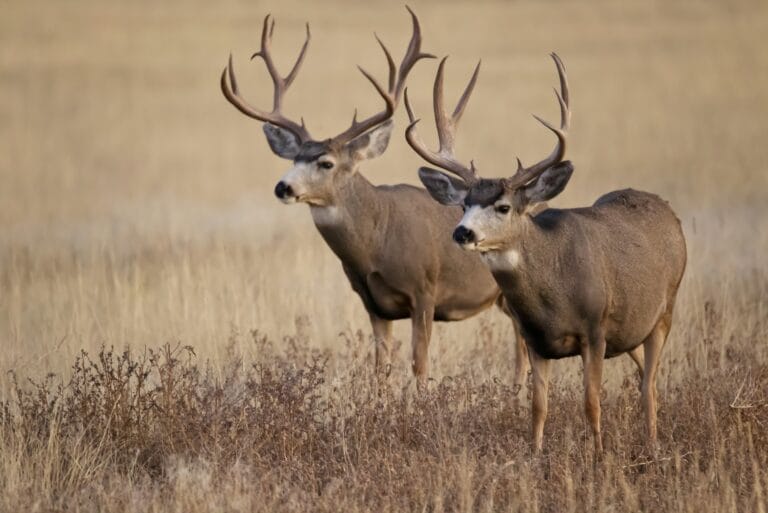
Deer populations can decline by 30 to 40 percent, and over half the animals can be infected with CWD. Hunters can’t simply hunt and fill the freezer; they must wait weeks for test results to know if the meat is safe.
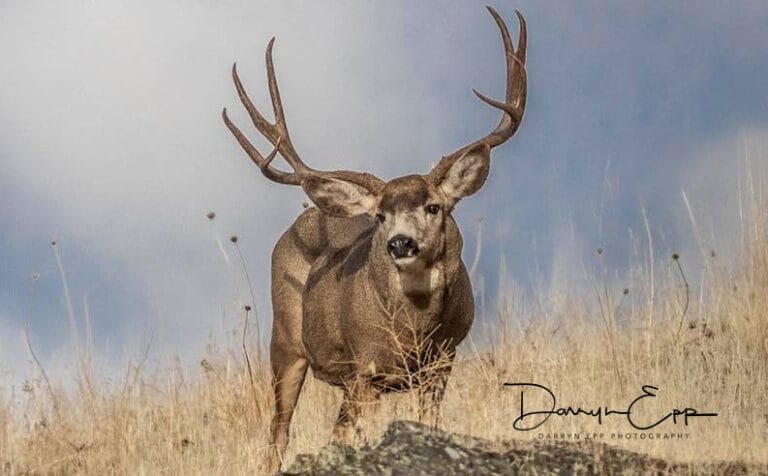
The whole rhythm of hunting — being outdoors, harvesting food, sharing it with family — changes. I can’t even fathom packing a muley buck off a Rocky Mountain peak, hanging it, butchering it, and then throwing it in the garbage six weeks later.
That’s what’s at stake here in the Kootenays.
CWD is a prion disease – like mad cow. CWD infects members of the deer family – elk, moose, deer, and caribou. There are no known vaccines or post-exposure treatments, it is always fatal and can take years to take effect. CWD is not currently thought to infect humans, but it has the potential to cross the species barrier.
If that occurs, scientists predict that the disease would act like Creutzfeldt-Jakob Disease, the disease people get from mad cow. Prions can be shed into the environment via body fluids and ingested by new animals. It’s a nasty and persistent disease.
CWD showed up quietly in British Columbia, but it’s not something we can take lightly.
In early 2023, two deer south of Cranbrook tested positive. Since then, four more cases have followed, all from the same general area near Cranbrook. Three were harvested by licensed hunters, and one came from the Cranbrook urban deer removal.
That last one really matters: it confirmed that CWD isn’t just in the wild herds around Cranbrook — it’s also in the town deer, which means that not only are town deer a local reservoir for the disease, but that the prions that these deer shed will concentrate in the towns’ urban green spaces, like city parks and playgrounds.
The province has taken some positive steps — new carcass transport rules, mandatory testing, roadkill disposal and sampling, and town deer sampling— but things have moved too slowly. With CWD, doing “just enough” isn’t neutral.
Every winter we wait, this disease spreads further and settles deeper into our landscape. Research on deer movements show that some animals may travel over 50 km one way during their migrations – the potential for spread into and out of BC via natural deer movements alone is a huge concern for the region.
The Province worked with Cranbrook and Kimberley to sample town deer last winter. Government biologists worked tirelessly in Cranbrook, where the CWD risk was highest, to remove about 100 deer (of hundreds in town). One of those deer was positive.
That result told us clearly that the disease is here — both inside and outside of town — and it’s time to move faster. Yet a second round of removals was cancelled last winter.
The density of these town deer needs to be substantially reduced to avoid CWD accumulating in town. Without follow-through, town deer populations will again grow dense, allowing prions to build up year after year and CWD prevalence to increase.
There is a winter hunt planned outside of Cranbrook to reduce deer density adjacent to town, where disease spillover is likely. That’s a good and necessary step, shifting from caution to control, but it comes late.
By the time that hunt happens, it will have been three winters since the first detections — three full seasons of deer moving across the landscape and shedding prions into the soil. Those are seasons we can’t get back.
The ultimate success of this hunt will depend on how many deer can be harvested and past efforts in this area yielded low numbers due to few areas to successfully hunt in the zone.
What’s frustrating is that we saw this coming.
B.C. had a CWD Response Plan ready for years — one that laid out clear steps for early detection and rapid action. Yet when the disease arrived, the system hesitated. The plan was ready; the process wasn’t. We didn’t need to debate how to act — we just needed to act.
The good news is we still have a window, and acting decisively doesn’t mean wiping out deer across the landscape. Targeted removals around known positive cases can act like a firebreak — a local safeguard meant to contain the spread and protect the rest of the herd. Done properly, they’re focused, temporary, and effective.
In other jurisdictions, these approaches have seen success in limiting or eradicating (at least temporarily) CWD in hotspots when done quickly, and intensely.
Here’s what needs to happen now. First, focus removal around confirmed cases and stick with it for several years — that’s where science says you get the best results. This includes managing urban deer to much lower densities.
Second, double down on prevention — strict carcass and transport rules, rapid testing (results should come in days. Not weeks or months under the current system), and expanded surveillance to other areas of BC so we can spot new cases early.
And finally, have triggers ready ahead of time. When a new positive shows up, the response should begin within weeks, not months or years.
We’ve spent years preparing for CWD and three years watching it creep forward. Let’s make this winter the turning point.
With courage and coordination, we can keep this small and contained. CWD doesn’t wait for funding cycles or public consultation. Every winter we act, we buy time. Every winter, we hesitate; we lose ground. The time to act is now.
Clayton Lamb is a wildlife scientist with Biodiversity Pathways and the University of British Columbia, working at the interface of population ecology, human-wildlife coexistence, and endangered species recovery.
Original Post: https://cranbrooktownsman.com/2025/10/28/column-cwd-response-cant-wait/