This project is an initiative by Hunters for BC focused on slowing the spread of Chronic Wasting Disease in British Columbia.
We’re hunters, volunteers, and conservationists taking action for wildlife in British Columbia. Your donation helps protect the wildlife, wild spaces, and hunting heritage that make this a unique place.
This project is heavily self-funded; it is a passion project for us. Your donation goes a long way. Thank you; your support is greatly appreciated.
Join us in keeping the Hunt. Gather. Conserve. spirit alive.
Donate Today
Will Hunting Work to Control CWD in British Columbia? Yes.
Jessica Russell has spent her career managing and planning responses for large disease and invasive pest incursions at the national level in New Zealand and in Canada. She translates disease management theory into application and has planned successful responses to primarily animal health threats but also plant pests, foodborne outbreaks and adverse events. Highlights include leading the eradication of Gumboro disease from New Zealand’s poultry sector, planning and overseeing the response to New Zealand’s largest ever outbreak of Salmonella Enteritidis, and developing the management research programme for the newly introduced granulate ambrosia beetle. Within Canada, she has supported the Planning Epidemiology Unit of the Highly Pathogenic Avian Influenza Response with the CFIA, and supports the Province’s response to Chronic Wasting Disease in BC.
Managing wildlife diseases is complex. In many cases, control efforts focus on the thing that actually causes the disease, like E. coli behind food poisoning or the virus responsible for rabies. Chronic wasting disease (CWD), however, is different. Its causative agent is a prion, and prions are notoriously tough. They persist in the environment, resist breakdown, and leave wildlife managers with very few options for direct intervention.
Because we can’t realistically target the prion itself, CWD management must focus on the animals that carry it and how they interact with one another. That shifts the conversation away from treatment and chemistry and toward deer behaviour, population density, and, sometimes controversially, harvest.
hunting works. It works best when applied early, maintained consistently to reduce density, and focused on high-risk animals. Results take time, but today’s decisions shape tomorrow’s data.
Jessica Russell, Response Planning Specialist
How CWD moves through deer populations is critical to understanding how it can be controlled. When the disease first arrives on the landscape and prevalence is low, transmission mostly occurs within herds rather than between them. Many deer species, especially white-tailed deer, form strong matrilineal groups where females remain close to their mothers’ home ranges. Contact rates within herds can be 10–30-fold times higher than between animals of different herds, making disease spread far more likely among close social groups.
Across larger areas, where herds are spread out and densities are lower, interactions decline, and the risk of CWD jumping between herds is reduced. Problems arise as densities increase. High density within herds means more contact and a higher chance that a single infected animal spreads disease to its herd-mates. When density is high both within and between herds, CWD can spread between herds and rapidly across the landscape, increasing overall disease prevalence.
Another well-established pattern is that male deer are infected more often than females, typically 1.5-3 times more frequently. This isn’t random. Male deer tend to live riskier social lives: they form bachelor groups, fight during the rut, roam farther, and disperse more widely. All of these behaviours increase contact rates and opportunities for disease transmission. From a management perspective, this makes males a clear focal point for control efforts.
So, while we can’t neutralize the prion, we can influence how often it’s passed from one host to another. Reducing deer density and removing individuals most likely to become infected has consistently been shown to keep CWD prevalence low.
For British Columbia, the timing couldn’t be better. Current CWD prevalence remains well below 1%, putting the province in a strong position to act decisively. BC is following the science, through special hunts, early engagement with hunters, and robust surveillance, but success depends on hunter participation.
Jessica Russell, Response Planning Specialist
To do that effectively, managers need to know where the disease is, making surveillance essential. For some wildlife diseases, test-and-cull programs allow selective removal of infected animals. Unfortunately, CWD doesn’t allow that luxury. Reliable testing requires samples collected after death, and while live-animal testing exists, it’s invasive and impractical at the scale of wild populations.
That leaves a dual-purpose strategy: removing animals to both detect disease and reduce its presence on the landscape. Conveniently, there’s already a system in place that does exactly that: recreational harvest.
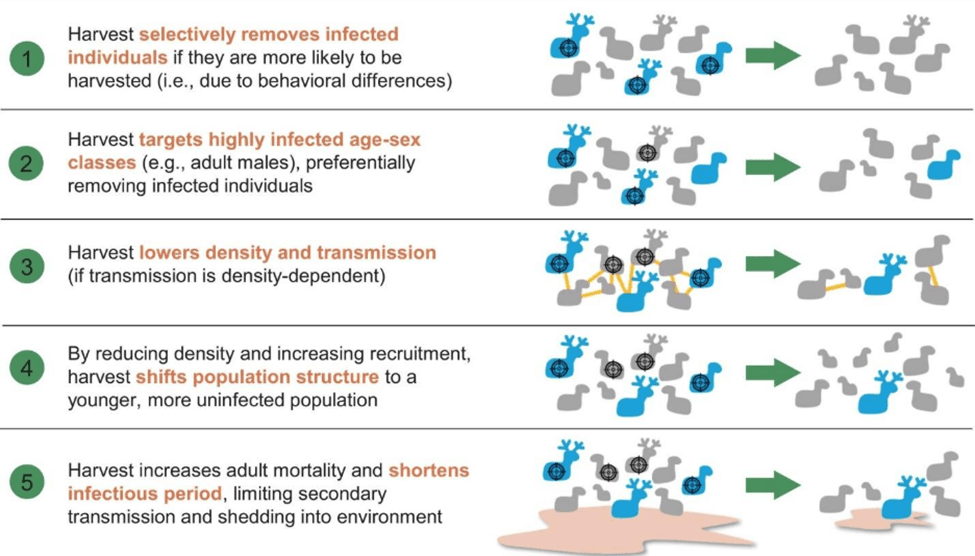
Hunting provides surveillance samples while removing potentially infected animals at the same time. Over the past two decades, a growing body of research has shown that harvest isn’t just convenient, it’s effective, particularly when it targets high-risk individuals (Fig 1).
Figure 1: Mechanisms linking harvest to reductions in disease prevalence, which can occur at the same time. Infected individuals are depicted in blue (Moss, et al., 2025)
One of the strongest examples comes from a 2021 study by Dr. Mary Conner, which examined 36 mule deer herds across North America. The study found that higher rates of male harvest were strongly associated with lower CWD prevalence—but only when prevalence was low to begin with, around 5% or less. The message is clear: harvest works best early. Applying pressure quickly, before the disease gains momentum, can significantly slow its spread.
Real-world management supports this. Illinois is often cited as a CWD success story, having kept statewide prevalence below 2% for more than 16 years. The state combined targeted either-sex hunts in affected areas with broader density reduction, and supplemented regular hunting seasons with focused winter culling around known hotspots. Colorado and Wisconsin offer cautionary contrasts: where hunting pressure or hunter participation declined, CWD prevalence increased. Both states’ CWD prevalences are currently sitting over 40% in hotspots.
Timing is another important piece of the puzzle. Many studies show a one- to two-year lag between changes in harvest pressure and visible changes in disease prevalence. What happens this season won’t show up in the data until later. CWD is a slow-moving disease, and managing it requires patience.
Skepticism around harvest is understandable. Wildlife systems are messy, and separating cause from coincidence is difficult. That’s why a 2025 study by Wynne Moss and colleagues in Wyoming is so important. Using 20 years of data, the researchers showed that higher male harvest rates directlycaused reductions in CWD prevalence. They have dispelled the rumour that rising disease levels were simply driving changes in harvest.
Put simply: hunting works. It works best when applied early, maintained consistently to reduce density, and focused on high-risk animals. Results take time, but today’s decisions shape tomorrow’s data.
For British Columbia, the timing couldn’t be better. Current CWD prevalence remains well below 1%, putting the province in a strong position to act decisively. BC is following the science, through special hunts, early engagement with hunters, and robust surveillance, but success depends on hunter participation.
Managing chronic wasting disease isn’t easy, and there’s no silver bullet. New technologies and genetic tools may help in the future, but they’re still a long way off. For now, the science is clear: harvest remains one of the most effective tools we have.
Literature Referenced
Conner, Mary M., Mary E. Wood, Anne Hubbs, Justin Binfet, A. Andrew Holland, Luke R. Meduna, Annette Roug, Jonathan P. Runge, Todd D. Nordeen, Margo J. Pybus, et al. “The relationship between harvest management and Chronic wasting disease prevalence trends in western mule deer (Odocoileus hemionus) herds.” The Journal of Wildlife Diseases 57, no. 4 (2021): 831–843. https://doi.org/10.7589/JWD-D-20-00226.
Grear, D. A., M. D. Samuel, K. T. Scribner, B. V. Weckworth, and J. A. Langenberg. 2010. Influence of genetic relatedness and spatial proximity on chronic wasting disease infection among female white-tailed deer. Journal of Applied Ecology47: 532–540. https://doi.org/10.1111/j.1365-2664.2010.01813.x
Miller, Michael W., Jonathan P. Runge, A. Andrew Holland, and Matthew D. Eckert. “hunting pressure modulates prion infection risk in mule deer herds.” The Journal of Wildlife Diseases 56, no. 4 (2020): 781–790. https://doi.org/10.7589/JWD-D-20-00054.
Moss, Wynne E., Justin Binfet, L. Embere Hall, Samantha E. Allen, William H. Edwards, Jessica E. Jennings-Gaines, and Paul C. Cross. 2025. “The Effectiveness of Harvest for Limiting Wildlife Disease: Insights from 20 years of Chronic Wasting Disease in Wyoming.” Ecological Applications 35(1): e3089. https://doi.org/10.1002/eap.3089
Rogers, W., Brandell, E. E. & Cross, P. C. (2022). Epidemiological differences between sexes affect management efficacy in simulated chronic wasting disease systems. Journal of Applied Ecology, 59, 1122–1133. https://doi.org/10.1111/1365-2664.14125
Storm, D. J., M. D. Samuel, R. E. Rolley, P. Shelton, N. S. Keuler, B. J. Richards, and T. R. Van Deelen. 2013. Deer density and disease prevalence influence transmission of chronic wasting disease in white-tailed deer. Ecosphere 4(1):10. http://dx.doi.org/10.1890/ES12-00141.1