This project is an initiative by Hunters for BC focused on slowing the spread of Chronic Wasting Disease in British Columbia.
We’re hunters, volunteers, and conservationists taking action for wildlife in British Columbia. Your donation helps protect the wildlife, wild spaces, and hunting heritage that make this a unique place.
This project is heavily self-funded; it is a passion project for us. Your donation goes a long way. Thank you; your support is greatly appreciated.
Join us in keeping the Hunt. Gather. Conserve. spirit alive.
Donate Today
CWD in BC: What we’ve learnt from across the Rockies.
Jessica Russell has spent her career managing and planning responses for large disease and invasive pest incursions at the national level in New Zealand and in Canada. She translates disease management theory into application and has planned successful responses to primarily animal health threats but also plant pests, foodborne outbreaks and adverse events. Highlights include leading the eradication of Gumboro disease from New Zealand’s poultry sector, planning and overseeing the response to New Zealand’s largest ever outbreak of Salmonella Enteritidis, and developing the management research programme for the newly introduced granulate ambrosia beetle. Within Canada, she has supported the Planning Epidemiology Unit of the Highly Pathogenic Avian Influenza Response with the CFIA, and supports the Province’s response to Chronic Wasting Disease in BC.
Chronic wasting disease was identified as a prion disease in the late 1970s and retroactively diagnosed in mule deer in Colorado in 1967. Since then, we’ve learnt a lot about how it spreads between animals, moves through landscapes and, importantly, how we can try to manage it.
The jurisdictions wrestling with CWD in the early years were fighting an unknown enemy. They worked by trial and error, trying to reduce prevalence, learning from successes and failures, and adapting as the science improved.
The jurisdictions wrestling with CWD in the early years were fighting an unknown enemy.
British Columbia has an advantage….
Jessica Russell, Response Planning Specialist
British Columbia has an advantage: over 50 years of lessons to draw on, including 25 years of experience from our eastern neighbours. Looking at Saskatchewan and Alberta gives us some useful clues about what works, what doesn’t, and what BC can do differently.
That said, provinces that have detected CWD do not all begin their management challenge from the same starting line. Important differences include:
Cervid migration differs between prairie and mountainous landscapes[1][2];
Mule deer and white-tailed deer differ in land use and group behaviour, impacting their probability of infection[3];
Hunter engagement differs among provinces; and
The timing of CWD occurrence allows later-affected jurisdictions to learn from places such as Illinois.
The Saskatchewan story
Saskatchewan was the first Canadian province to face CWD in farmed and then wild cervids. The disease was imported in farmed elk from South Dakota in the 1980s and first detected in farmed elk in Saskatchewan in 1996. Limited testing of wild deer and elk began in 1997, and CWD was detected in a wild mule deer in 2000.
The science of CWD was still developing. Between 1997 and 2000, only the obex (brain stem) was tested. Retropharyngeal lymph nodes – now the gold-standard diagnostic tissue for testing deer – were not added until 2001. Animals under a year old were tested until 2005; today, these young animals are generally excluded because infection is less likely to be detectable, resulting in possible false negatives.
After CWD appeared in wild cervids, Saskatchewan’s surveillance effort waxed and waned depending on hunter and political support. Between 2001 and 2008, a well-funded program with the Canadian Wildlife Health Cooperative received up to 7,000 hunter submissions each year. Participation dropped sharply after 2009, and by 2012 only 506 samples were submitted. The program was defunded in 2013, leaving hunters to pay $120 per animal for testing. Hunter-harvest surveillance all but disappeared.
The program was reinstated in 2015 but saw low uptake. By then, provincial prevalence in the deer tested was approaching 15%. In 2017, Saskatchewan shifted toward targeted surveillance in priority wildlife management units, including areas where managers wanted to detect potential movement of the disease into northern boreal ecosystems.
Submission numbers never returned to the early-2000s peak, while prevalence continued to climb. By 2024, CWD hotspots in the South Saskatchewan River Valley had prevalence up to 92% (± 11%) in male mule deer and 62% in females (± 19%), the highest known CWD prevalence in the world[4]. Recent survey data show significant mule deer declines in heavily affected areas, with CWD considered an important contributor. For example, in WMZ 2W, between 2019 and 2025, the mule deer population declined by over 60%.
In 2025/26 a combination of harsh winters, drought and CWD has left the mule deer season essentially closed in the South Saskatchewan River Valley and severely limited elsewhere. White-tailed deer numbers also declined, leading to shorter seasons and buck-only harvest in some areas.
Alberta’s CWD adversary
Alberta’s story is different. Alberta began provincial CWD surveillance in wild deer and elk in 1998 and targeted the Saskatchewan border area in fall 2000. In spring 2005, the province carried out a proactive herd reduction near Chauvin, removing almost 500 animals. However, in fall 2005, an emaciated mule deer at Acadia Valley (~200 km south of Chauvin) near the Alberta/Saskatchewan border tested positive for CWD. Targeted disease control was applied in the area and three more positives were found. Deer head submission became mandatory along parts of the AB/SK border in 2006[6].
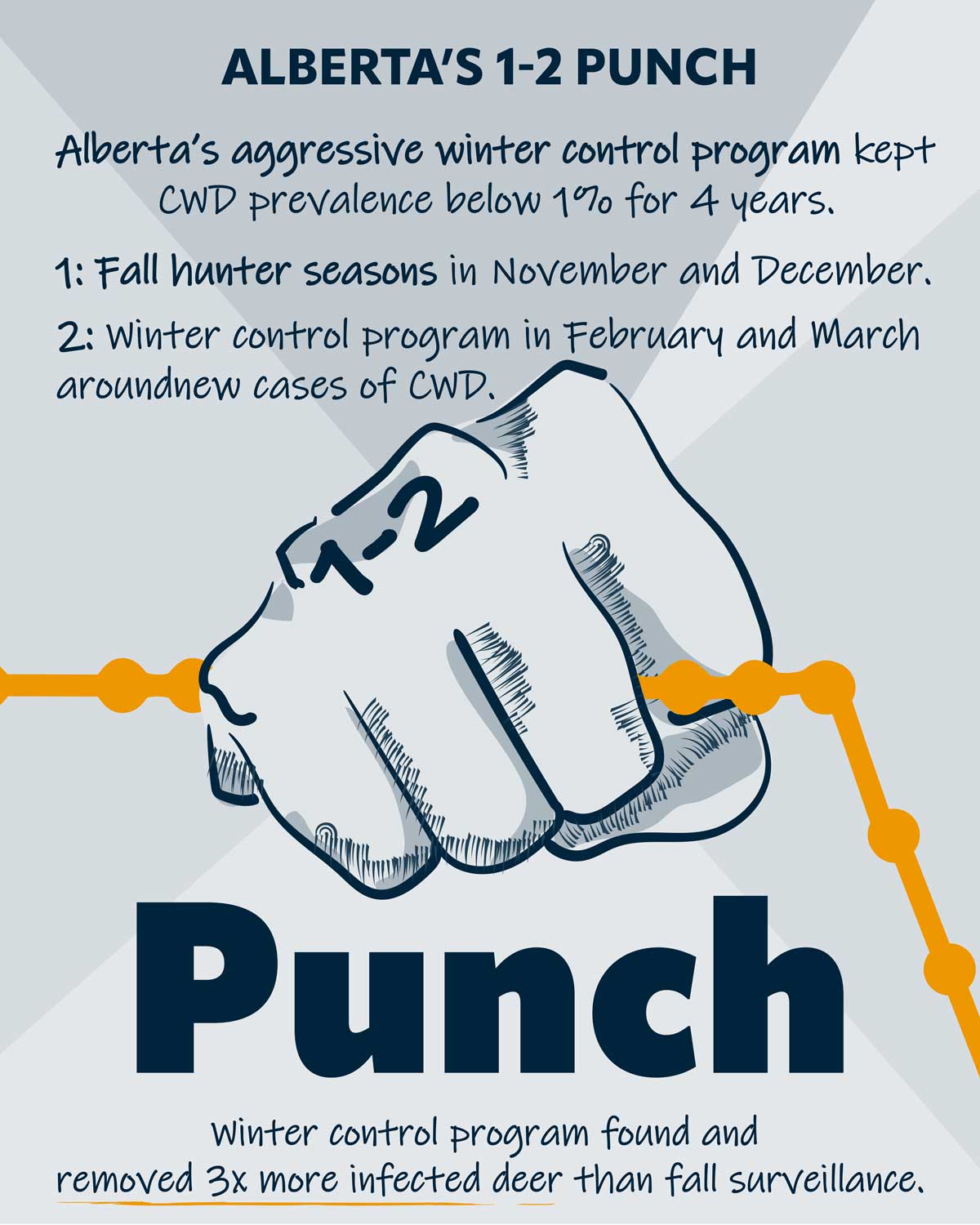
Alberta took an immediate aggressive response to finding CWD in wild deer. They developed a 1-2 Punch program that involved:
fall hunter surveillance to identify priority areas around CWD cases; followed by
targeted winter control in February and March to focus deer removals in those areas.
The winter program removed around three times as many infected deer as fall hunter surveillance while also lowering local herd density. During the program, provincial prevalence remained below 1%. A similar program applied in Illinois kept prevalence below 2% for 20 years[7].
During the program, Alberta CWD prevalence remained below 1%. A similar program applied in Illinois kept prevalence below 2% for 20 years.
Jessica Russell, Response Planning Specialist
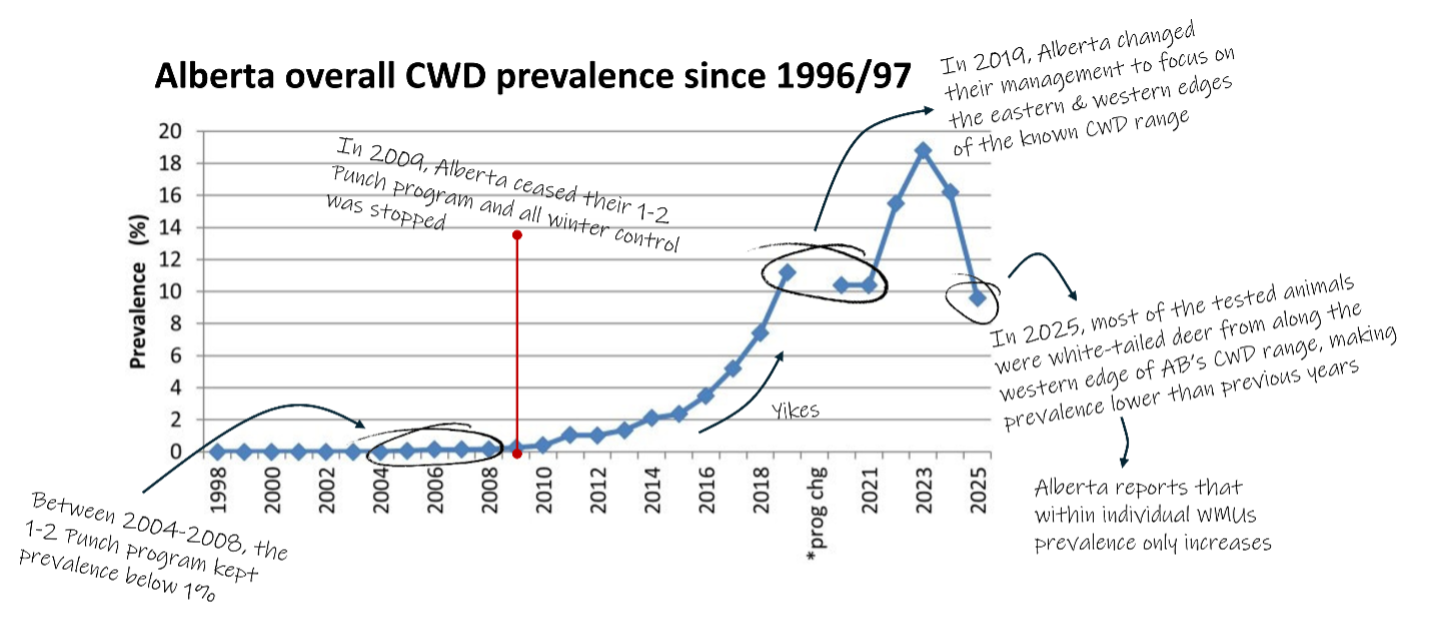
But these programs need public, landowner, hunter and political support. Although Alberta generally had strong support, local opposition to killing deer was voiced by a few residents. The winter program was suspended and shelved in 2009. In the following years, hunter support remained high along the Alberta–Saskatchewan border, despite the time lag between submitting heads and receiving results.
By 2011, CWD surged in the South Saskatchewan and the Battle River Valleys, where the winter programs had previously suppressed prevalence, and continued spreading west and north. One year, a new detection appeared more than 100km from previous cases, but overall CWD spread was a steady and incremental expansion. By 2018, overall prevalence in tested mule deer had reached 12%, and prevalence peaked in 2023 at 18.8%. As of 2026, CWD is present in 82 Alberta WMUs, and prevalence in male mule deer exceeds 70% in some wildlife management units along the AB/SK border[8]. Alberta’s consistent surveillance and monitoring of CWD have made the province a world leader in CWD research.
Twenty years after detection, the effects are now becoming visible. Alberta Provincial Wildlife Disease Specialist Dr. Margo Pybus has noted that “deer populations are declining where CWD has been present the longest, especially older bucks, and hunter harvest is also falling.” Mule deer quotas have been reduced in eastern Alberta in response.
So, what can we learn from across the Rockies?
Early bird keeps CWD prevalence low
The best window for management is early, while prevalence is still low. Once CWD rises above a few percent, bringing prevalence back down becomes extremely difficult. From that point, management is often about slowing the increase rather than reversing it. Alberta and Illinois both show that sustained disease control efforts combined with harvest pressure can help keep prevalence low.
Consistency is key
CWD management is a long game. Alberta’s 1–2 Punch program kept prevalence low while it was operating, but once the program stopped, prevalence rose steadily and CWD spread across the landscape. “Our two-pronged approach of combined hunter surveillance followed by targeted local disease control was effective,” says Pybus. “If it had been allowed to continue there is no doubt in my mind that AB would have far less CWD than we have [now].” BC’s winter Cranbrook hunt works as a general “second punch” to complement the province’s hunting season surveillance.
Teamwork makes the dream work
Deer don’t recognize provincial borders. One jurisdiction’s uncontrolled spread can undermine its neighbour’s response. We have seen the same issue between Illinois and Wisconsin. For BC, continued westward movement from Alberta and northward spread from US states such as Montana and Idaho, especially along natural river corridors, creates an ongoing source of potential infection pressure. We must collaborate across borders.
You miss 100% of the shots you don’t take
There is a view that CWD is impossible to manage, so there is little point trying. Pybus strongly disagrees. “BC has the best chance of any jurisdiction since the incursion likely has limited temporal, numerical, and geographic presence,” she says. “Also, your province took a collaborative approach from the beginning and this will help maintain the social support, particularly important now that the decisions are getting harder and more sensitive.”
“…deer populations are declining where CWD has been present the longest, especially older bucks, and hunter harvest is also falling.”
Dr. Margo Pybus, Alberta Provincial Wildlife Disease Specialist
The lessons from Alberta and Saskatchewan show us that CWD management is NOT easy. But early action, consistent pressure, good surveillance and public support is essential to buy time – and once that window closes, the opportunities become much more limited.
BC is in a great position to keep CWD prevalence low. Support from hunters across BC is vital and good surveillance submissions since CWD was detected in 2024 provides an optimistic outlook. The Cranbrook winter hunt gives BC’s response that extra oomph, learning from Alberta’s 1-2 Punch experience.
Always submit cervid heads to a dedicated CWD sample collection freezer. Sample drop off locations can be found here.
Literature Cited:
1 Hygnstrom, S. E., Groepper, S. R., VerCauteren, K. C., Frost, C. J., Boner, J. R., Kinsell, T. C., & Clements, G. M. (2008). Literature review of mule deer and white-tailed deer movements in western and midwestern landscapes. Great Plains Research, 18(2), 219–231. http://www.jstor.org/stable/23779915
2 Kinley, T.A. 2019. Seasonal movements of White-tailed Deer (Odocoileus virginianus) in the Rocky Mountains of British Columbia. Canadian Field-Naturalist 133(3): 246–252. https://doi.org/10.22621/cfn.v133i3.2201
3 Susan Lingle. 2003. Group composition and cohesion in sympatric white-tailed deer and mule deer. Canadian Journal of Zoology. 81(7): 1119-1130. https://doi.org/10.1139/z03-097
H4BC Hunt.Gather.Conserve. Society recognizes the Habitat Conservation Trust Foundation for making a significant financial contribution to support Strengthening Hunter Participation in CWD Surveillance and Compliance. Partnerships are key to conserving BC’s wildlife, fish, and their habitats.