This project is an initiative by Hunters for BC focused on slowing the spread of Chronic Wasting Disease in British Columbia.
We’re hunters, volunteers, and conservationists taking action for wildlife in British Columbia. Your donation helps protect the wildlife, wild spaces, and hunting heritage that make this a unique place.
This project is heavily self-funded; it is a passion project for us. Your donation goes a long way. Thank you; your support is greatly appreciated.
Join us in keeping the Hunt. Gather. Conserve. spirit alive.
Jessica Russell has spent her career managing and planning responses for large disease and invasive pest incursions at the national level in New Zealand and in Canada. She translates disease management theory into application and has planned successful responses to primarily animal health threats but also plant pests, foodborne outbreaks and adverse events. Highlights include leading the eradication of Gumboro disease from New Zealand’s poultry sector, planning and overseeing the response to New Zealand’s largest ever outbreak of Salmonella Enteritidis, and developing the management research programme for the newly introduced granulate ambrosia beetle. Within Canada, she has supported the Planning Epidemiology Unit of the Highly Pathogenic Avian Influenza Response with the CFIA, and supports the Province’s response to Chronic Wasting Disease in BC.
Chronic wasting disease (CWD) is caused by prions. Prions are misfolded proteins that cause their next-door neighbour healthy proteins to misfold too. In infected animals, prions are found in many tissues, with the highest concentrations in the nervous and lymphatic systems, including the brain, spinal cord, lymph nodes, and eyes. They shed in body fluids such as saliva, blood, urine, feces, and reproductive fluids.
One of the reasons CWD is so difficult to manage is that prions are extremely hard to destroy. Even after an infected animal dies, prions can remain in the environment and stay infectious for years. Studies have shown that prions can persist in contaminated environments for over a decade. When another deer, elk, moose, or caribou comes into contact with contaminated tissues, fluids, soil, or plants, they themselves can become infected and spread CWD.
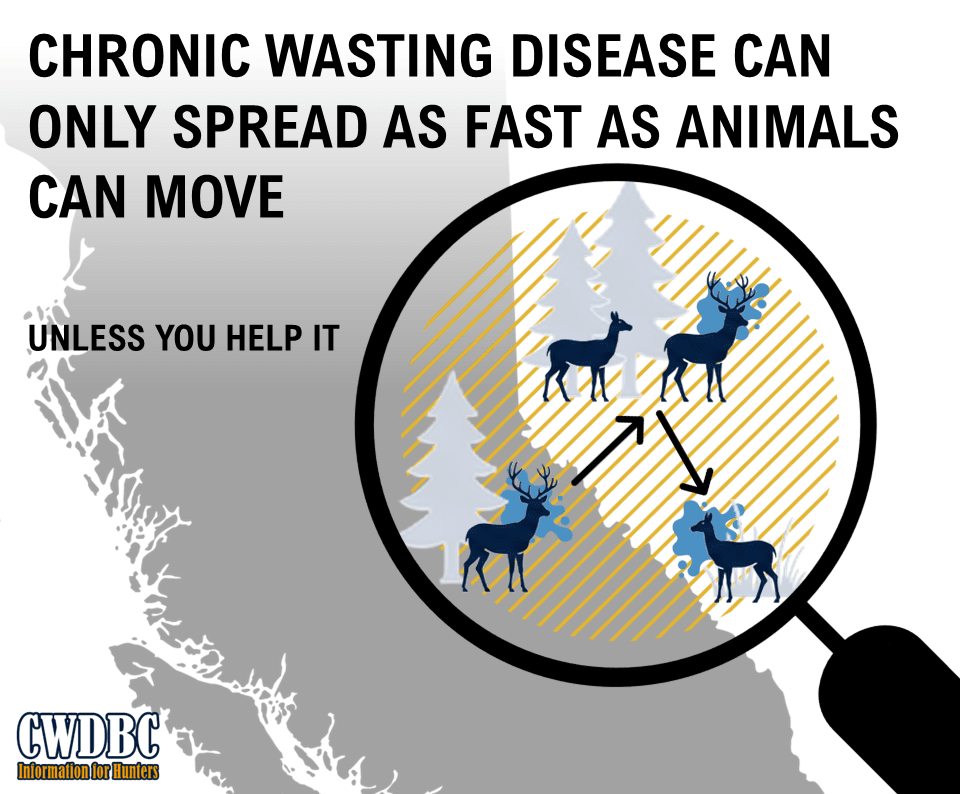
If CWD only moved through natural deer movements, we would expect to see the disease slowly expand outward from infected areas. Since its identification in a captive mule deer herd in Colorado in 1968, however, CWD has not spread in a neat circle. Instead, its distribution across North America shows jumps: slow local spread in some places, then sudden appearances in new states, provinces, or countries that cannot be explained by natural cervid movement alone. Lucky for prions and unlucky for cervids, CWD has humans to help it spread far and wide.
Those jumps are largely caused by people.
…sudden appearances in new states, provinces, or countries that cannot be explained by natural cervid movement alone.
Live animal movements and contaminated carcasses are considered among the biggest risks for introducing CWD into new areas. For example, CWD spread from Colorado to Wyoming through captive herd movements, then to South Dakota, and later to Saskatchewan through infected farmed elk. From Canada, infected elk were exported to South Korea. In the United States, infected animals were also moved to places such as Oklahoma, Montana, and Nebraska. By the early 2000s, many midwestern states had detected CWD in captive cervid herds, with additional spillover into wild populations.
The movement of CWD is usually unintentional. Hunters, farmers, and processors are not actively trying to spread disease, but moving live animals, whole carcasses, heads, spinal columns, or contaminated equipment can give prions a ride.
Governments have introduced regulations to reduce this risk. For example, British Columbia does not allow live cervids to be imported without a permit and areas where CWD has been detected, Management Zone regulations restrict the movement of highrisk tissues, such as brain and spinal cord, out of the zone. Urine-based lures are also prohibited.
However, regulations only work when people know about them and follow them. In BC, CWD testing freezers have received heads from CWD-positive deer hunted in Alberta and driven across the province. Heads from animals harvested inside the BC Management Zone have also been dropped off at freezers far outside the zone.
In BC, CWD testing freezers have received heads from CWD-positive deer hunted in Alberta and driven across the province.
Jessica Russell, Response Planning Specialist
The bad news: human-mediated movement is one of the biggest risks for CWD spread.
The good news: it is also one of the easiest risks to prevent.
1. Before you hunt, know the rules
If you are hunting in BC’s CWD Management Zone (WMUs 4-1 to 4-8 and 4-20 to 4-25), head submission for CWD testing is mandatory. Brain tissue and the spinal column may not leave the Management Zone unless being taken directly to a sample collection freezer. If you hunt within the Zone, you must submit your head within the Zone too, this helps the Province prioritize testing and your results will be returned much faster.
That means no transporting whole carcasses out of the Management Zone. It also means that if you hunt outside BC, you should not bring whole carcasses or high-risk tissues back into the province. Before each hunt, check the rules for both where you are hunting and where you are going home.
2. Dispose of carcass waste properly
Dumping carcasses or carcass parts away from the kill site is an easy way to spread CWD. A head, spine, or pile of bones left behind at camp, beside a road, or near a field can become a source of contamination. Scavengers may also drag tissues around.
Where possible, field dress the animal and leave inedible parts at the kill site. Debone the meat in the field and avoid transporting the brain, spinal column, or other high-risk tissues. If you harvested the animal in the Management Zone, always dispose of the carcass within the Zone. The best option is to bury carcass remains at the kill site, and failing that, a landfill within the Zone. Outside the Management Zone, on-site burial is also a good option where permitted; otherwise, dispose of carcass waste at an approved landfill.
Always submit cervid heads to a dedicated CWD sample collection freezer. Sample drop off locations can be found here.
3. Use good biosecurity practises when processing deer
CWD prevalence in BC is currently low, but caution is pertinent. There is no definitive evidence that CWD spreads to humans like bovine spongiform encephalopathy, or “mad cow disease”, but public health agencies recommend reducing exposure and not eating meat from CWD-positive animals. Wear gloves when field dressing and processing. A disposable apron and boot covers are useful, particularly when handling viscera including blood, bone, brain, lymph nodes, or spinal tissues. Good biosecurity practise means avoiding using leather or fabric gloves and boots where disposable or washable options are available.
Hunters are not the problem, they are part of the solution and key to managing CWD prevalence.
Jessica Russell, Response Planning Specialist
Ideally, keep two sets of tools: one for high-risk tissues, such as cutting through bone, spine or brain, and another for meat. Do not use knives or saws that have contacted high-risk tissues on edible portions.
Clean tools by scrubbing them with soap and water to remove all visible organic matter and disinfect them with a bleach solution of 2-2.5% NaClO (20,000–25,000 ppm available chlorine) solution by soaking them for an hour.
Finally, label and freeze meat from animals harvested in the Management Zone until CWD test results are available.
Hunters are not the problem, they are part of the solution and key to managing CWD prevalence. By knowing the rules, handling carcasses carefully, submitting samples, and keeping high-risk tissues where they belong, hunters can help protect healthy herds and keep BC’s cervid populations thriving for hunting traditions to continue for the future generations.